
AI can build you a website in minutes. But can it build a website that actually works for your business?
AI is changing the way websites are built, and we're not going to pretend otherwise.
Tools like Lovable, Wix AI and other AI website builders are making it easier than ever to generate a website without knowing how to code or hiring a web designer.
And we think that's pretty cool.
But there's a difference between having a website and having a good website. An even bigger difference between having a good-looking website and having one that actually supports your business goals.
The question isn't whether AI can build your website. It's whether AI knows enough about your business to build the right one.
Let's get into it.
First, Can AI Actually Build a Good Website?
Yes. AI can generate functional, visually appealing websites, and for some businesses, that might be all they need.
If you're launching a small side project, testing a business idea, building a simple landing page or working with a limited budget, an AI website builder can be a great starting point.
Depending on the platform, AI can help you:
Generate website layouts and page structures
Write initial website copy and headings
Suggest colours, typography and imagery
Build responsive pages and website components
Create basic functionality and interactive elements
Get a website online much faster than traditional development
That's impressive, and we're here for technology that makes building a business more accessible.
But here's where things get interesting.
AI is only as effective as the information, direction and context you give it.
And that's where a lot of business owners run into trouble.
AI Doesn't Know Your Business. You Have to Teach It.
Imagine asking an AI website builder to create a website for a Canadian clothing brand.
You might give it a prompt like:
"Build me a modern, feminine e-commerce website for a Canadian clothing brand that sells comfortable clothing for girls and tweens. Use pastel colours and make it fun and professional."
Chances are, you'll get something pretty decent.
You'll probably see some nice colours, a hero image, product collections, a few buttons and a layout that looks like an online store.
But here's what AI doesn't automatically know.
Your brand. What makes your business different? What's your personality? Are you playful, sophisticated, bold, approachable or a little unconventional?
Your customers. Who is actually visiting your website? What are their frustrations, concerns and motivations? What information do they need before they're comfortable making a purchase?
Your story. Why does your business exist? What problem are you solving? What makes someone choose you over the dozens of other businesses offering something similar?
Your messaging. What should visitors understand within the first five seconds of landing on your website? What do you want them to feel, remember and do next?
Your competitors. Who are you competing against in search results? What keywords are they targeting? How are they structuring their content, headings and metadata?
Your business goals. Are you trying to generate leads, sell products, book consultations, educate customers or build trust in a new brand?
AI can work with this information.
But someone needs to research it, understand it and provide the right direction.
And that's a big part of what professional website strategy actually involves.
Let's Look at a Real Example: AI Website Design vs. Human-Led Design
We wanted to put this into perspective using a real website project from Olive Grey Creative.
For Globerry, a Canadian clothing brand creating comfortable, thoughtfully designed essentials for girls and tweens, we explored what an AI-generated website concept could look like.
The result?
Not bad at all.
It had a clean layout, product imagery, navigation, calls to action and the basic structure of an e-commerce website.
It was a starting point.
But when you compare that initial concept with the website we designed and executed at Olive Grey Creative, you start to see what thoughtful website strategy and design actually bring to the table.
The AI-generated starting point

The AI concept included several standard e-commerce elements: a hero banner, product categories, featured products, a brand comparison table and a size guide.
These are all useful components.
But the design relied heavily on familiar e-commerce patterns. It didn't fully capture Globerry's personality, its founder's story or the emotional considerations involved in shopping for a girl's first bra.
The foundation was there. The brand experience wasn't quite there yet.
The Olive Grey Creative website:
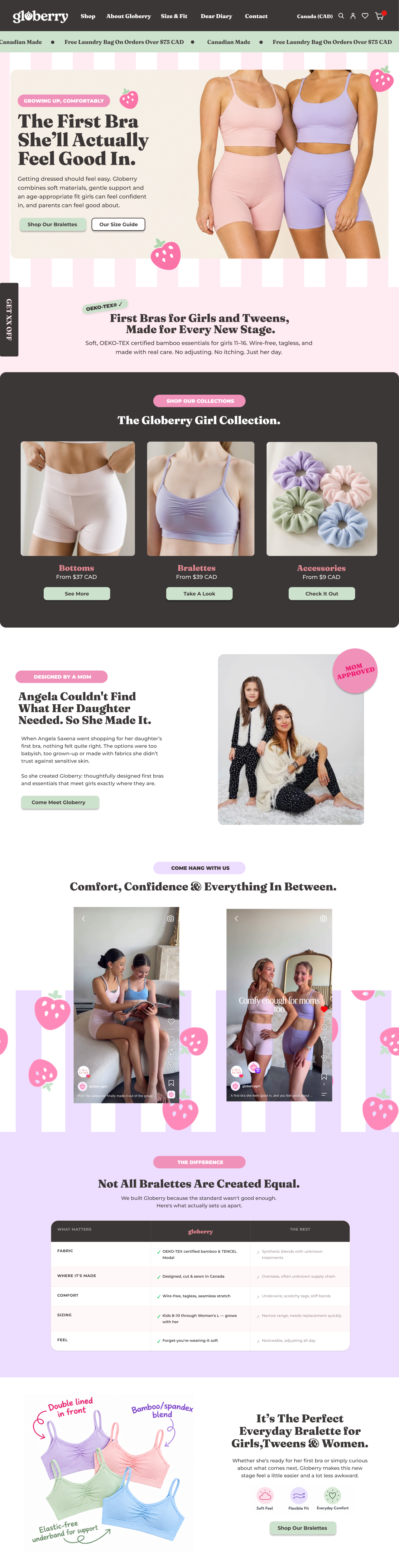
Now look at the website we created.
The difference isn't simply the colours, fonts or imagery.
It's the research, strategy and thinking behind the experience.
We approached the website with a deeper understanding of who Globerry is speaking to, what its customers are searching for, what competitors are doing and how the brand should make visitors feel.
Here's what went into it:
1. Messaging Backed by Actual Keyword Research
One of the first things we did was research the keywords potential customers were using to find products like Globerry's.
We identified "first bra" as an important search term with strong search visibility and impressions.
That's valuable information.
It tells us how people are searching for this type of product, and it gives us an opportunity to build the website around language that customers are already using.
But we didn't stop at keyword research.
We also analyzed competing brands and reviewed their:
Homepage H1 headings and supporting headlines
SEO title tags and meta descriptions
Keywords used throughout their website content
Product and collection page messaging
Search positioning and content structure
The goal wasn't to copy competitors.
It was to understand what they're targeting, identify opportunities and create a stronger, more relevant experience for Globerry's customers.
That's how we arrived at the homepage headline:
"The First Bra She'll Actually Feel Good In."
This headline works on multiple levels.
It incorporates the target keyword "first bra," helping search engines understand the relevance of the page.
It speaks directly to the customer by addressing one of their biggest concerns: finding a first bra that's actually comfortable.
And it communicates the brand's value in a way that's memorable, relatable and consistent with Globerry's personality.
It's not just a clever headline. It's a strategic decision backed by research.
Of course, including a keyword in a heading doesn't automatically mean a website will rank above its competitors. But when keyword research, search intent, relevant content and technical SEO work together, you're building a much stronger foundation for organic visibility.
That's the kind of thinking that should happen before website copy is finalized, not after the website launches.
2. A Brand Personality That Feels Consistent
From the playful strawberry graphics and pastel palette to the typography, buttons and custom visual elements, the website feels distinctly Globerry.
These details aren't simply decorative.
They help establish a recognizable brand personality that appeals to its audience and makes the shopping experience feel approachable and fun.
An AI builder can generate a pastel colour palette and attractive product sections.
But translating a brand's personality into a cohesive visual experience requires direction, consistency and an understanding of the people you're designing for.
3. Storytelling That Builds Trust
Globerry wasn't created just to sell clothing.
Its founder, Angela, started the brand after struggling to find suitable first bras for her daughter.
That's an important story.
It explains why the brand exists, what problem it's solving and why parents might feel more confident purchasing from a business created by someone who experienced the same frustration.
Rather than burying that story on an About page, we introduced it directly on the homepage.
Because sometimes the story behind a business is just as important as the product itself.
4. Product Education That Supports Buying Decisions
Shopping for a first bra can involve a lot of questions.
Is it comfortable? Is the fabric suitable for sensitive skin? How does sizing work? What makes these products different?
These are the questions that influence whether someone feels confident enough to make a purchase.
We considered those concerns when planning the website's content and layout.
The homepage includes product messaging, collection navigation, a comparison table and educational content to help customers understand what makes Globerry different.
This is where website strategy and user experience come together.
Instead of simply displaying products, we're helping customers make informed decisions.
5. A More Intentional Visual Experience
We considered how the different sections work together, how information is grouped, what catches someone's attention and how visitors move through the page.
We also considered the balance between brand storytelling, product discovery and conversion opportunities.
The goal wasn't just to make the website look pretty.
It was to make it easier for customers to understand the brand, find what they need and feel confident purchasing.
That's the difference between generating a website and designing an experience.
And to be clear, AI can contribute to every one of these things when it's given the right direction.
The important part is having someone who knows what that direction should be.
A Pretty Website Isn't Necessarily a Good Website
This is probably one of the biggest misconceptions we see in web design.
People assume that if a website looks professional, it must be effective.
Not necessarily.
A website can have beautiful imagery, modern typography, smooth animations and an impressive layout, and still leave visitors confused about what the business actually offers.
That's because good web design isn't just about appearance.
It's about user experience (UX).
User experience is how someone interacts with your website, how easily they can find information and how confidently they can complete the action they came to take.
Think about the last time you visited a website and couldn't find the pricing, struggled to understand the services or had to click through five pages to find an answer.
Annoying, right?
Now imagine your potential customers experiencing that on your website.
What Good Website UX Actually Considers
Before designing a website, we think about questions like:
Who is visiting this website, and what brought them here?
What information are they looking for first?
What questions or objections might prevent them from taking action?
How should the content be organized so it's easy to understand?
What should someone do after reading each section?
How does the experience work on mobile devices?
Are navigation, forms and calls to action clear and accessible?
These aren't simply design decisions.
They're business decisions.
AI can suggest layouts and user journeys, but it doesn't automatically know how your specific customers behave or what barriers prevent them from converting.
That requires research, context, testing and thoughtful decision-making.
What About SEO? Can AI Build a Website That Ranks on Google?
AI can help create an SEO-friendly website, but using an AI website builder doesn't automatically mean your website is optimized for search engines.
And this is a big one.
Because what's the point of launching a beautiful new website if your ideal customers can't find it?
Search engine optimization (SEO) should be considered from the beginning of a website project, not treated as something to figure out after launch.
Let's go back to our Globerry example.
We didn't simply write a headline that sounded nice and hope people would find the website.
We researched the keywords customers were using, looked at competing websites and evaluated how those search terms could be incorporated naturally into Globerry's content.
That research influenced the homepage headline, but it also helped inform the broader content strategy.
This is an important distinction.
SEO isn't about adding keywords to a finished website. It's about using search data to help determine what the website should say and how the information should be organized.
SEO Involves More Than Asking AI to Add Keywords
A well-optimized website considers:
Keyword research: Understanding the actual words and phrases people use when searching for your products or services, along with their relevance, search demand and competitive landscape.
Competitor research: Reviewing competing websites, their page structures, headings, title tags, meta descriptions and the search terms they appear for. This helps identify opportunities to differentiate your content and target relevant searches.
Search intent: Identifying whether someone wants information, is comparing options or is ready to make a purchase.
Website structure: Creating logical pages, navigation and internal links that help both visitors and search engines understand your content.
Headings and website copy: Using relevant keywords naturally in H1s, H2s and page content without sacrificing readability or brand voice.
Title tags and meta descriptions: Writing unique, descriptive metadata informed by keyword research and page intent. Meta descriptions can influence how a result is presented, although search engines may generate their own snippets.
Technical SEO: Making sure the website can be crawled and indexed, loads efficiently, works on mobile and avoids preventable technical issues.
Image optimization: Using descriptive file names, meaningful alt text and appropriately sized images.
AI can assist with all of these tasks.
But here's the catch.
If you don't know what needs to be optimized, how do you know whether AI has done it correctly?
AI might suggest keywords that sound relevant but have little actual search demand.
It might write a headline that's catchy but misses an important keyword opportunity.
Or it might generate generic title tags and descriptions without considering what competing websites are targeting.
This is why actual keyword data, competitor analysis and human review matter.
The goal isn't simply to have a website that Google can find.
It's to build a website that has a meaningful opportunity to compete in search results.
And Now There's AEO: Optimizing Your Website for AI Search
SEO isn't the only consideration anymore.
We're also thinking about Answer Engine Optimization (AEO), which focuses on making website content easier for AI-powered search and answer experiences to discover, understand and reference.
Think about how people are starting to search.
Instead of only typing a few keywords into Google, they're asking tools like ChatGPT, Perplexity and Google's AI-powered search experiences complete questions.
For example:
"What's the best website platform for a small service business?"
Or:
"What should I look for when buying my daughter's first bra?"
AEO involves creating content that clearly answers relevant questions, demonstrates expertise and provides useful, accurate information.
That can include:
Clear, descriptive headings written around real customer questions
Direct answers followed by useful explanations
FAQ sections that address common concerns
Well-organized, helpful website content
Consistent information about your business and services
Appropriate structured data where relevant
Original insights, examples and evidence of expertise
AEO isn't a magic trick that guarantees your business will appear in AI-generated answers.
And adding a few FAQs to your website isn't an AEO strategy.
The foundation is still useful, trustworthy, well-structured content.
Your website needs to communicate clearly to people first, while making that information accessible to search engines and AI systems.
That's something we consider alongside SEO when planning websites at Olive Grey Creative.
AI Can Write Your Website Copy. But Will It Sound Like You?
You've probably noticed that a lot of AI-generated website copy sounds suspiciously similar.
Something about unlocking potential, transforming experiences or taking your business to the next level.
You know the type.
It's not necessarily bad writing.
It's just generic.
And generic messaging is a problem when you're trying to stand out in a crowded market.
Your website copy should communicate your personality, explain your value and give customers a reason to remember you.
That requires understanding your brand's tone of voice.
Are you direct and confident? Warm and conversational? Playful and witty? Professional and technical?
What words would your brand never use?
What do your customers care about most?
And just as importantly, what language are they actually using when they search for your business?
Because effective website copy needs to do two things:
Connect with your audience and help them find you.
The Globerry headline is a great example of how those two goals can work together.
It uses a relevant search term without sounding like it was written for a search engine.
It still feels human.
AI can learn your brand voice when you provide examples, guidelines, keyword research and context.
But without that direction, it's often filling in the blanks with language that could belong to almost any business.
Your website shouldn't sound like everyone else's just because everyone is using the same tools.
AI Website Builder vs. Professional Web Designer: What's the Difference?
Here's how we'd compare the two approaches.
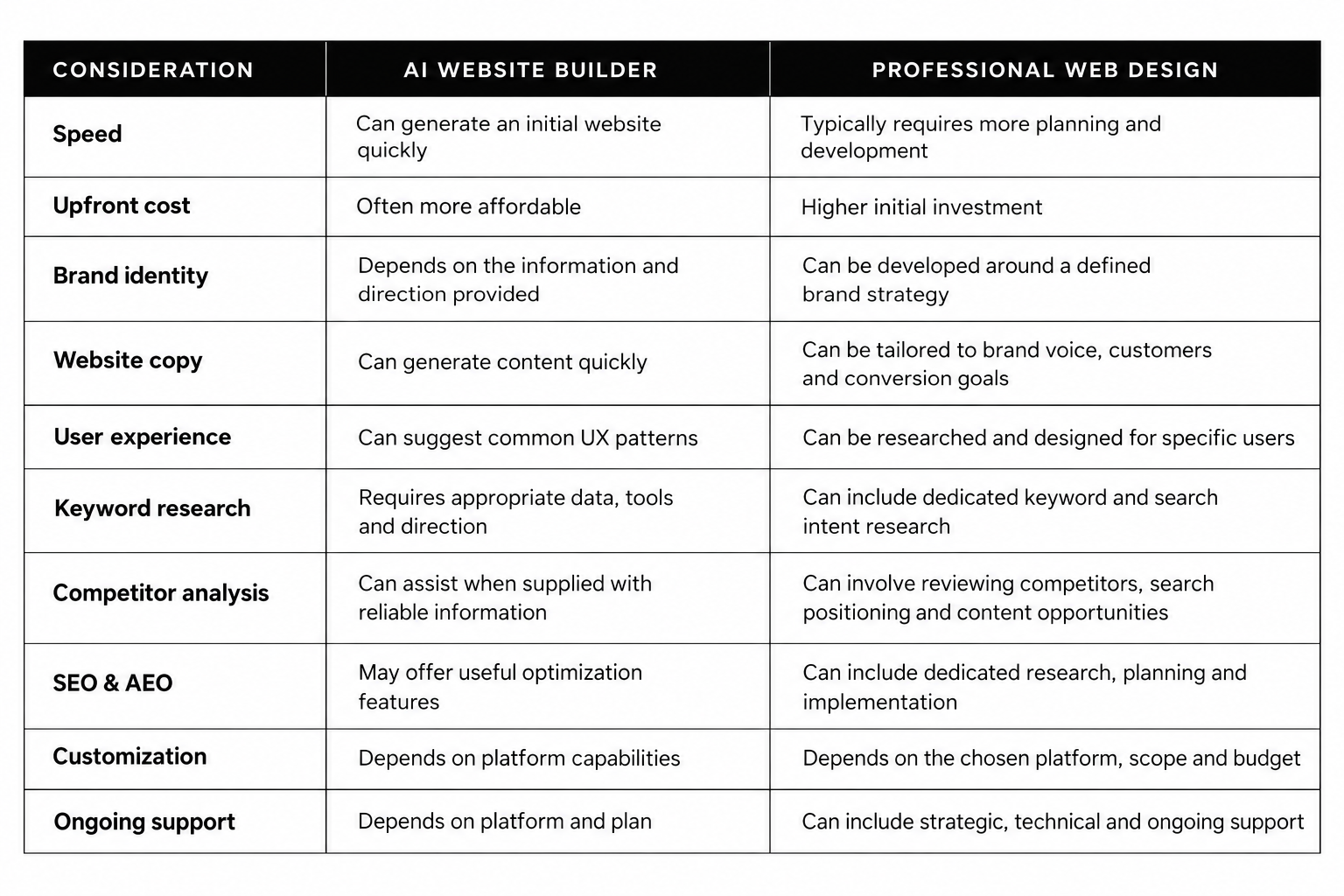
Neither approach guarantees a successful website.
A poorly planned professional website can underperform just as easily as an AI-generated one.
And a well-directed AI website can be effective.
The difference comes down to the strategy, expertise and execution behind it.
So, Should You Use AI to Build Your Website?
Here's how we'd look at it.
Yes, Consider AI If...
You're just getting started, have a limited budget, need a simple website or want to test an idea before investing in something more substantial.
AI can also be a useful tool for brainstorming layouts, exploring content ideas and getting an initial website concept together.
Consider Professional Web Design If...
Your website is an important part of how your business generates revenue, attracts leads, sells products or builds credibility.
Especially if you need:
A distinct and consistent brand experience
A website designed around specific customer needs
Keyword and competitor research before content development
SEO and AEO considered from the beginning
Strategic content organization and conversion-focused messaging
More complex functionality or e-commerce requirements
Someone to manage the technical details, quality assurance and ongoing improvements
And there's a third option that we think deserves more attention.
Use AI and Human Expertise Together
It doesn't have to be one or the other.
AI can be an incredibly useful part of the website design and development process.
It can speed up research, help generate ideas, support content development and reduce repetitive work.
But someone still needs to ask the right questions, evaluate the output, make strategic decisions and ensure the final website actually serves the business.
That's where experience matters.
The Bottom Line: AI Is a Tool. Strategy Is What Makes It Work.
We're not against AI-built websites.
We're against the idea that generating a website automatically means you've created something effective.
Because a website isn't just a collection of sections, images and buttons.
It's often someone's first introduction to your business.
It's where potential customers decide whether they trust you, understand what you offer and want to take the next step.
And it's an opportunity to show up when someone searches for the exact product or service you provide.
Those things don't happen just because a website looks good.
They happen through a combination of research, strategy, messaging, design and execution.
AI can build the pages. But it takes strategy to build the experience.
At Olive Grey Creative, we believe good websites start with understanding the business, the brand, the competition and the people on the other side of the screen.
The technology used to build them is only one part of the equation.
Building a Website? Let's Make Sure It Actually Works for Your Business.
Whether you're starting from scratch, redesigning an existing website or trying to improve something you've already built with AI, we can help you figure out what's working, what's missing and what needs to happen next.
Frequently Asked Questions About AI Website Builders
-
Yes, AI website builders can be a good option for simple websites, small businesses, landing pages and early-stage projects. However, more complex websites may benefit from professional guidance on branding, user experience, SEO, content strategy and conversion optimization.
-
AI can automate many website design and development tasks, but it doesn't automatically replace the research, strategy, creative direction and judgment involved in professional web design. The best approach depends on the business's goals, budget and website requirements.
-
AI-generated websites can perform well in search engines when they are properly structured, optimized and maintained. However, AI-generated content alone doesn't guarantee rankings. Keyword research, competitor analysis, search intent, technical SEO and helpful content still matter.
-
AI can help identify potential keywords, organize keyword lists and analyze search intent. However, reliable keyword research requires actual search data to assess demand, competition and relevance. AI-generated keyword suggestions should be validated before being used to plan website content.
-
AI can help identify potential keywords, organize keyword lists and analyze search intent. However, reliable keyword research requires actual search data to assess demand, competition and relevance. AI-generated keyword suggestions should be validated before being used to plan website content.
-
Item description
-
Potential disadvantages include generic branding, limited customization on some platforms, inaccurate or repetitive copy, insufficient SEO planning and user experiences that aren't tailored to specific audiences. These issues can often be improved with better prompts, research and human review.
-
AI website builders generally have lower upfront costs than hiring a professional web design agency. However, businesses should also consider subscriptions, hosting, integrations, maintenance, revisions and the time required to create and manage the website.
Consider This Your Sign to Get in Touch.That website refresh you've been thinking about? The SEO you've been meaning to tackle? The project that's been sitting on your to-do list? We should probably talk.
